The Starting Line: Why Zero Is Actually an Advantage
Let’s address the most paralyzing myth in the creator economy: "I need an audience before I can build anything." This case study dismantles that belief. It follows a solo operator who launched a niche productivity site with exactly what most beginners have: zero domain authority, zero backlinks, zero email list, and zero prior SEO experience. No paid ads. No viral social strategy. Just a structured content system and patience.
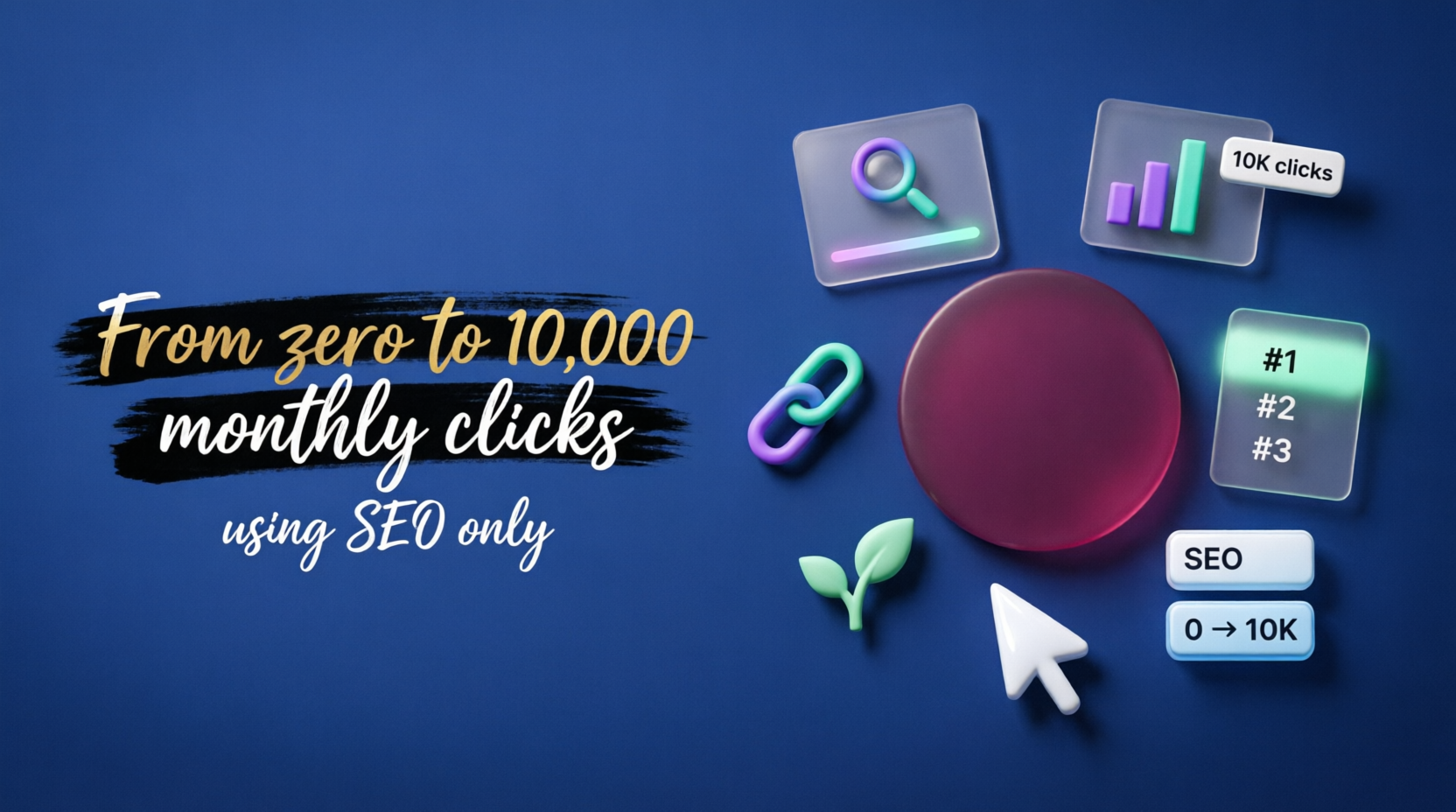
Twelve months later, that site consistently clears 10,000+ monthly organic clicks. Not from luck. Not from a single viral post. From architectural discipline.
Starting from zero isn't a disadvantage—it's a clean slate. There are no legacy penalties, no bloated content archives diluting topical focus, and no audience expectations forcing premature monetization. Constraints breed precision. And precision is what search engines reward in 2026.
The 3-Pillar SEO Engine
Random publishing doesn't scale. Systems do. The creator didn't guess what to write; they engineered a repeatable framework built on three non-negotiable pillars. Each pillar addresses a specific algorithmic signal, and together they form a compounding growth loop.
| Pillar | Algorithmic Signal | Creator Action | Business Outcome |
|---|---|---|---|
| 1. Semantic Clustering | Topical Authority & Entity Recognition | Map hub-and-spoke content networks around core themes | Faster ranking velocity, reduced bounce, higher session depth |
| 2. Intent-First Keyword Mapping | Query Satisfaction & Click-Through Potential | Target low-competition, high-intent long-tail queries | Higher conversion rates, predictable traffic, lower CAC |
| 3. Consistency as a Technical Signal | Crawl Budget Allocation & Freshness | Maintain a predictable publishing cadence with technical hygiene | Accelerated indexing, compounding authority, sustainable scale |
This isn't theory. It's the exact operating system that moved the site from sandbox obscurity to 10K monthly clicks. Let's break down how each pillar was executed.
1. Semantic Clustering: Topical Authority Over Keyword Stuffing
Modern SEO doesn't reward isolated articles. It rewards semantic networks. Search engines evaluate content holistically: Can this site comprehensively cover a topic? Does it demonstrate experience, expertise, and structured knowledge? The answer lies in clustering.
Instead of publishing random posts like "5 Time Management Tips" and "Best Laptops 2026," the creator built focused content ecosystems. Each cluster operated like a mini-silo:
- Pillar Page (Hub): "The Complete Remote Work Productivity Stack" (3,500+ words, comprehensive overview)
- Support Pages (Spokes): "Async Communication Tools for Distributed Teams," "Focus Blocks for ADHD Freelancers," "Notion vs ClickUp for Solopreneurs"
- Internal Linking Protocol: Every spoke links contextually back to the pillar. The pillar links out to spokes using descriptive anchor text. No orphan pages. No forced keyword matching.
This structure signals topical depth to crawlers, distributes link equity efficiently, and keeps users engaged longer. When Google sees a tightly interlinked network covering a niche comprehensively, it rewards the entire cluster with higher rankings—not just individual pages. For a real-world breakdown of how cluster architecture drives exponential traffic, see our case study: how a content cluster strategy generated 50,000 monthly visitors in 8 months.
2. Intent-First Keyword Mapping: Scaling Through Specificity
Chasing high-volume keywords is the fastest way to burn out. Established sites with 5+ years of authority will always outrank a new domain for broad terms like "productivity apps." The creator bypassed this trap by targeting low-competition, high-intent long-tail queries.
Keyword selection followed a strict validation matrix:
| Keyword Type | Search Volume | Intent | Why It Works |
|---|---|---|---|
| "best task manager for freelance writers" | 120/mo | Commercial | Low competition, high purchase readiness, easy to outrank |
| "how to batch content creation without burnout" | 210/mo | Informational → Commercial | Builds trust, captures email leads, naturally leads to tool recommendations |
| "Notion vs Asana for small teams 2026" | 350/mo | Comparison | High CTR, long dwell time, strong affiliate conversion potential |
The strategy wasn't about volume; it was about query satisfaction. Each keyword was mapped to a specific user problem, and the content was structured to answer it completely. By dominating dozens of micro-intent queries, the creator built a traffic mosaic that compounded faster than chasing a single viral term. For a complete framework on attracting and converting high-intent visitors, explore Traffic Domination 2026: How to Attract High-Intent Visitors.
3. Consistency as a Technical Signal
Consistency isn't just a mindset; it's a technical requirement. Search engines allocate crawl budget based on predictable update patterns. A site that publishes erratically signals low priority. A site that ships high-quality content on a fixed cadence trains crawlers to index faster and rank sooner.
The creator implemented a Minimum Viable Cadence: two comprehensive articles per week, published every Tuesday and Thursday. No exceptions. No "waiting for inspiration." This rhythm achieved three critical outcomes:
- Crawl Optimization: Googlebot learned to visit on predictable days, reducing indexing lag from 14 days to 3-5 days.
- Authority Compounding: Regular publishing signaled active expertise, accelerating topical authority signals.
- Data Feedback Loops: Consistent output generated consistent performance data, enabling rapid iteration on headlines, CTAs, and internal links.
Consistency doesn't mean daily posting. It means predictable, high-signal output that matches your capacity. For a complete system on structuring scalable content pipelines, see Creator Growth Systems: How to Build a Scalable Content Engine in 2026.
The Growth Timeline: Realistic Phases (Not Overnight Success)
SEO growth is delayed, then exponential. Understanding the phases prevents premature quitting and aligns expectations with algorithmic reality.
| Phase | Timeline | What's Happening | Key Metric |
|---|---|---|---|
| 1. The Invisible Foundation | Months 1–3 | Indexing, crawl budget allocation, sandbox evaluation. Zero visible traffic, but structural signals are building. | Indexed pages: 20–30 | Avg. Position: 45+ |
| 2. The Validation Window | Months 4–6 | First long-tail rankings emerge. CTR optimization begins. Data feedback informs content iteration. | Monthly Clicks: 800–1,500 | CTR: 2.1% → 3.8% |
| 3. The Compounding Curve | Months 7–12 | Topical authority kicks in. Secondary rankings multiply. Internal linking amplifies cluster strength. | Monthly Clicks: 10,000+ | Avg. Position: 12.4 |
The jump from 1,500 to 10,000 clicks didn't come from a viral spike. It came from the cumulative effect of 60+ interlinked articles, optimized meta data, and consistent technical hygiene. SEO rewards patience disguised as discipline.
Why This Actually Works (The Algorithmic Reality)
Search engines in 2026 don't just match keywords; they evaluate entity relationships, user satisfaction signals, and experience markers. This strategy works because it aligns with how modern algorithms assess quality:
- Topical Authority > Keyword Density: Clusters demonstrate comprehensive coverage, reducing the need for external backlinks in early stages.
- Intent Alignment > Traffic Volume: Long-tail commercial queries convert at 3-5x the rate of broad informational terms, maximizing RPV.
- Consistency > Perfection: Predictable publishing trains crawl budgets, accelerates indexing, and builds algorithmic trust faster than sporadic "perfect" posts.
- Internal Link Equity > External Links: A well-structured silo passes ranking power efficiently, allowing new sites to compete without expensive link-building campaigns.
When you stop treating SEO as a traffic hack and start treating it as infrastructure, the math becomes predictable. For advanced conversion frameworks that turn this traffic into revenue, dive into Conversion Mastery 2026: Turn More Clicks Into Commissions and Maximize Revenue Per Visitor: The 2026 Playbook.
The Replicable Blueprint: Your Step-by-Step Execution Checklist
This isn't a unique talent. It's a documented system. Follow this phased approach to replicate the results:
- Phase 1: Niche & Cluster Mapping (Weeks 1-2)
- Identify 3 core topics with commercial intent
- Map 1 pillar + 4-6 supporting articles per cluster
- Validate keywords using intent filters (commercial, comparison, problem-solving)
- Phase 2: Content Production (Weeks 3-8)
- Write pillar pages first (comprehensive, experience-driven)
- Produce support articles with specific angles, real testing data, and clear CTAs
- Implement internal linking protocol before publishing
- Phase 3: Technical & Distribution Hygiene (Ongoing)
- Submit sitemap, fix crawl errors, optimize Core Web Vitals
- Add schema markup (Article, FAQ, HowTo) for rich snippets
- Publish on fixed cadence; track indexing velocity in Search Console
- Phase 4: Iteration & Scaling (Months 4+)
- Optimize underperforming meta titles for CTR
- Update top clusters quarterly with fresh data
- Expand into adjacent clusters once authority solidifies
For a comprehensive look at structuring diversified, intent-aligned revenue models that survive algorithm shifts, explore Monetization Models for Creators in 2026.
Final Insight: SEO Is Infrastructure, Not a Hack
Reaching 10,000 monthly clicks doesn't require a viral moment, a massive budget, or an existing audience. It requires architectural patience. SEO is the only digital asset class that appreciates while you sleep. Every well-structured article becomes a permanent revenue node. Every internal link compounds authority. Every consistent publish cycle trains algorithms to favor you.
The creators who win aren't the ones chasing trends. They're the ones building systems that outlast them. Start with zero. Map your clusters. Publish consistently. Iterate based on data. Let the compounding curve do the heavy lifting.
Traffic follows structure. Revenue follows intent. Scale follows patience. Build the infrastructure, and the clicks will come.
Frequently Asked Questions
How long does it realistically take to reach 10,000 monthly clicks?
With consistent execution, most niche sites hit 1,000-2,000 clicks by month 4-6, and 10,000+ by month 8-12. Timeline depends on niche competitiveness, content depth, and technical hygiene. SEO is a delayed exponential curve, not a linear sprint.
Do I need backlinks to rank from zero?
Not in the early stages. Topical authority built through semantic clustering and internal linking can outrank established sites for long-tail queries. Backlinks accelerate growth, but they aren't a prerequisite for initial traction. Focus on content architecture first; earn links naturally through depth and utility.
What's the biggest mistake beginners make with SEO?
Publishing random articles without a cluster strategy, then abandoning the site after 60 days of "no results." SEO requires indexing time, crawl budget allocation, and topical signal accumulation. Consistency in the first 90 days is the difference between sandbox stagnation and compounding growth.
How do I know which keywords to target?
Use the 3C Framework: Commercial intent, Clear query, Competitor gap. Target long-tail phrases with 50-500 monthly searches, low keyword difficulty, and explicit purchase or problem-solving intent. Validate by checking if top results are thin, outdated, or lack real experience. If you can do it better, you can outrank it.
Can I monetize this traffic effectively?
Absolutely. High-intent SEO traffic converts at 3-5x the rate of social traffic. Map content to buyer journey stages, embed contextual affiliate links or digital product CTAs, and track RPV weekly. For a complete funnel blueprint, see The Ultimate Affiliate Funnel for High-Converting Traffic in 2025.
What tools are essential for this strategy?
Keep it lean: Google Search Console (indexing & performance), Ahrefs/Ubersuggest (keyword validation), a CMS with clean schema support, and an integrated analytics dashboard to track CTR, CVR, and RPV. Tools should remove friction, not add complexity. The right infrastructure turns data into direction.