Why Most Growth Advice Is Misleading
If you've consumed creator economy content for more than a few months, you've heard the same exhausted playbook: "Post three times a day," "Ride the trending audio wave," "Hack the algorithm with these five tricks." It sounds actionable. It feels urgent. And in 2026, it's functionally useless.
Shortcuts don't build businesses. They build anxiety. Viral spikes are lottery tickets—thrilling when they hit, devastating when they don't, and completely unpredictable when you actually need them. Algorithms have fundamentally shifted from engagement-maximizers to intent-predictors. Platforms no longer reward raw volume; they reward session retention, meaningful interaction, and commercial alignment. The creators scaling past 100,000 monthly visitors aren't chasing hacks. They're engineering predictability.
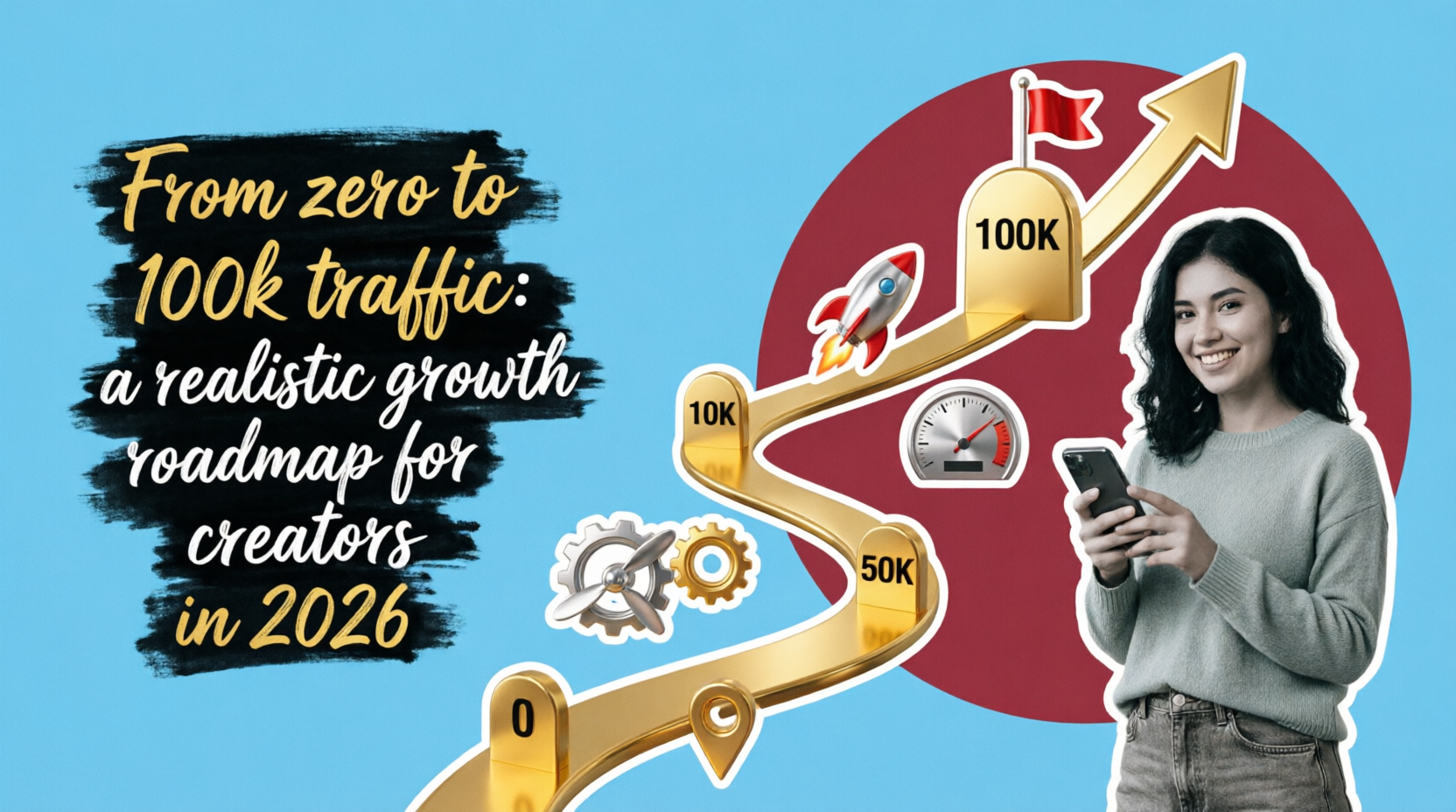
Real growth is slower at the start, more structured in the middle, and exponentially compounding at the end. It doesn't rely on luck. It relies on signal detection, framework standardization, and iterative optimization. This roadmap strips away the noise and gives you a phased, data-driven architecture to move from zero to 100k traffic—not through viral hope, but through systematic execution.
Stage 1: The First 1,000 Users (Validation & Signal Detection)
At zero to 1,000 monthly visitors, your only job is discovery. You're not building a brand yet. You're running a series of low-cost experiments to find content-market fit. The biggest mistake creators make at this stage is optimizing for perfection instead of signals. Perfection is a vanity metric. Signals are survival metrics.
Your focus should be hypothesis-driven creation. Every piece of content should answer a specific question: Will this hook retain attention? Does this format drive saves or shares? Does this topic align with existing search or community demand? You're not looking for home runs; you're looking for base hits that prove direction.
- Identify What Resonates: Track save rate, share rate, and average watch time/read depth. These signal genuine interest far more accurately than raw views. A post with 500 views and a 12% save rate is infinitely more valuable than one with 5,000 views and a 0.8% save rate.
- Test Formats, Not Just Topics: A tutorial might flop as a carousel but explode as a 60-second video. Test structure, pacing, and platform-native formatting before abandoning a topic. Use a simple testing matrix: 1 topic × 3 formats × 2 hooks = 6 data points per idea.
- Focus on Learning, Not Polish: Your first 20 pieces should be treated as data collection. Rough audio, simple editing, and direct messaging consistently outperform overproduced content with weak hooks. Ship at 80% quality. Let market feedback dictate improvements, not ego.
This stage is about finding your north star. When you see a consistent pattern—same topic, same format, above-average retention—you've found your signal. Everything else is noise. For a strategic framework on validating audience demand without burning out, explore our guide on Creator Growth Strategy: Building Authority That Converts.
Stage 2: 1,000 to 10,000 Users (Optimization & Systemization)
Once you've identified what works, the game shifts from exploration to exploitation. This is where most creators plateau. They keep experimenting instead of doubling down. In 2026, growth between 1k and 10k visitors is won by those who standardize winning patterns and remove production friction.
Your focus shifts to conversion-aligned consistency. You're no longer guessing what to post; you're deploying proven frameworks at a predictable cadence.
- Repeat Successful Content: Create 3-5 variations of your top-performing piece. Change the hook, update the examples, adjust the CTA, but keep the core structure intact. Familiarity breeds trust; trust breeds clicks. Audiences don't see every post, and even if they do, repetition reinforces authority.
- Optimize Headlines & Hooks: The first 3 seconds (video) or first line (text) determine 80% of your retention. A/B test curiosity gaps, problem-agitation openings, and result-first framing. Small hook improvements compound into massive traffic gains. Track hook retention rate weekly and iterate aggressively.
- Improve Consistency Through Batching: Dedicate one day to scripting, one to filming/writing, one to editing/scheduling. Batch production reduces context-switching fatigue and ensures you never miss a publish window. Consistency isn't about daily grind; it's about predictable rhythm.
Growth becomes stable when output is predictable. You're building a content rhythm that algorithms can recognize and audiences can rely on. This is the foundation of scalable distribution. For a complete breakdown of structuring repeatable content pipelines, see Creator Growth Systems: How to Build a Scalable Content Engine in 2026.
Stage 3: 10,000 to 100,000 Users (Infrastructure & Compounding)
Crossing the 10k threshold is a psychological and operational tipping point. You've proven demand. You've standardized output. Now, you transition from creator to operator. This phase isn't about working harder; it's about building leverage. Leverage comes from systems, delegation, and data-driven allocation.
Your focus shifts to asset multiplication and cross-channel synergy. You're no longer chasing individual posts; you're managing a portfolio of compounding content assets.
- Build Content Pipelines: Implement SOPs for research, scripting, editing, publishing, and repurposing. Document every step so output quality remains consistent even when you're not hands-on. Use template libraries for hooks, CTAs, and thumbnail structures to cut production time by 40-60%.
- Scale Distribution Channels Strategically: Don't add platforms randomly. Expand only when your primary channel hits consistent performance baselines (e.g., 3 consecutive months of target CTR/CVR). Repurpose top performers into native formats for secondary channels without diluting core effort. For a framework on disciplined expansion, see The One-Platform Strategy: How to Dominate Affiliate Marketing in 2026.
- Leverage Data Insights for Strategic Bets: Use CTR, CVR, and Revenue Per Visitor (RPV) to allocate resources. Double down on high-RPV topics. Retire or restructure underperformers. Invest in tools that automate tracking, scheduling, and analytics. Data transforms intuition into compounding growth.
This is where real growth happens. The gap between 10k and 100k isn't filled with viral moments; it's filled with compounding evergreen assets, internal linking clusters, email capture flows, and systematic optimization. For a roadmap on transitioning from sporadic income to scalable revenue architecture, explore How Creators Scale Affiliate Revenue in 2025.
Traffic Sources That Actually Scale in 2026
Not all traffic is created equal. Chasing volume without intent alignment is like filling a leaky bucket. In 2026, sustainable growth requires a diversified traffic portfolio that balances speed, stability, and conversion potential. Here's how the major channels actually perform:
| Channel | Growth Speed | Volatility | Intent Level | Best Use Case |
|---|---|---|---|---|
| SEO / Search | Slow (3-6 months) | Low | Very High | Evergreen reviews, comparison guides, problem-solving tutorials |
| Short-Form Video | Fast (days-weeks) | High | Medium | Top-of-funnel awareness, hook testing, viral trend adaptation |
| Niche Communities | Moderate | Low | Very High | Trust building, high-CVR recommendations, peer validation |
| Email / Owned | Slow build, fast activation | Very Low | Highest | Direct monetization, product launches, retention & LTV growth |
The optimal 2026 traffic mix isn't about picking one. It's about sequencing them strategically: Use short-form to capture attention, SEO to compound intent-driven traffic, communities to build trust, and email to own the relationship. For a strategic breakdown of attracting and converting high-intent visitors across these channels, see Traffic Domination 2026: How to Attract High-Intent Visitors.
The Compounding Effect: Why Consistency Outperforms Intensity
Growth is not linear. It's exponential. And the engine behind that exponent is compounding. Every piece of content you publish isn't just a post; it's an asset. When optimized correctly, it continues to attract visitors, generate clicks, and drive conversions long after you've moved on to the next project.
Here's the math of compounding content:
- Month 1: 5 posts → 500 visitors
- Month 2: 10 posts → 1,200 visitors (new posts + Month 1 still ranking)
- Month 3: 15 posts → 2,500 visitors (library compounds, internal linking boosts authority)
- Month 6: 30+ posts → 8,000+ visitors (search velocity increases, platform algorithms recognize topical authority)
This is why consistency beats intensity. A creator publishing three high-value pieces weekly for six months will almost always outperform a creator publishing daily for two weeks then burning out. The algorithm rewards predictable output. Audiences reward reliable value. And revenue rewards compounding assets.
Maximize compounding by implementing three structural habits:
- Internal Linking Clusters: Connect related posts to boost SEO authority, increase session duration, and guide users naturally toward conversion points.
- Evergreen Update Cycles: Refresh top performers quarterly with new data, pricing, or examples. Search engines reward freshness; audiences reward accuracy.
- Repurposing Loops: Slice long-form content into short-form hooks, carousels, and newsletter breakdowns without multiplying production time. One idea, five formats, zero extra research.
When you treat content as a library, not a feed, growth stops being a grind and starts being a flywheel. For advanced tactics on maximizing the value of every visitor, dive into Maximize Revenue Per Visitor: The 2026 Playbook.
Common Growth Bottlenecks (And How to Break Them)
Most creators don't fail because they lack talent. They fail because they hit structural bottlenecks and don't know how to dismantle them. Recognizing these traps early is the difference between stalling at 10k and scaling to 100k.
- Lack of Focus: Jumping between platforms, niches, and formats dilutes algorithmic trust and audience clarity. Fix: Master one channel, one niche, and three content formats before expanding. Use a 90-day single-platform sprint to build momentum.
- Inconsistent Posting: Sporadic output signals unpredictability to algorithms and audiences. Fix: Implement batch production, template-driven workflows, and a non-negotiable publishing calendar. Consistency is a system, not a mood.
- Data Blindness: Creating without tracking CTR, CVR, or RPV is flying blind. Fix: Set up integrated analytics from day one. Review performance weekly, iterate monthly. Let metrics dictate creative decisions, not assumptions.
- Platform Dependency: Building entirely on rented land leaves you vulnerable to policy shifts and algorithm updates. Fix: Drive traffic to owned assets (email list, website, community) to maintain attribution and relationship control. Platforms change; human problems don't.
- Perfection Paralysis: Waiting for "perfect" lighting, editing, or scripting delays market feedback. Fix: Ship at 80% quality. Optimize in public. Iteration beats stagnation every time.
Bottlenecks aren't roadblocks; they're signposts. They tell you exactly where your system needs reinforcement. Fix the leak, and growth resumes automatically.
The Long-Term Perspective: Thinking in Years, Not Months
The creator economy rewards patience disguised as discipline. Creators who measure success in monthly view counts will chase trends, burn out, and restart. Creators who measure success in yearly asset accumulation will build compounding libraries, deepen audience trust, and scale sustainably.
This mindset shift requires three architectural changes:
- From Campaigns to Infrastructure: Stop treating content as isolated promotions. Start treating it as interconnected assets that feed each other through links, email flows, and community touchpoints.
- From Vanity to Velocity: Stop optimizing for impressions. Start optimizing for revenue per visitor, return visitor rate, and conversion velocity. These metrics predict long-term viability far better than follower counts.
- From Scarcity to Moats: Your competitive advantage isn't a viral video. It's your unique voice, your documented experience, your community relationships, and your data-driven iteration speed. These are moats that algorithms can't replicate and competitors can't steal.
Growth in 2026 is a long-term game. The creators who win aren't the ones who spike and fade. They're the ones who show up, track, iterate, and compound—month after month, year after year. For a comprehensive look at structuring diversified, intent-aligned revenue models that survive algorithm shifts, explore Monetization Models for Creators in 2026.
Frequently Asked Questions
How long does it realistically take to reach 100k monthly visitors?
With consistent, system-driven execution, most creators hit 10k within 4-6 months and 100k within 12-18 months. SEO-driven content compounds slower initially but accelerates faster long-term. Short-form video can speed up early traction but requires strong retention optimization to sustain. Timeline depends on niche competitiveness, content quality, and iteration velocity.
Do I need to post daily to see growth?
No. Daily posting without strategy leads to burnout and diluted quality. Three to four high-value, well-optimized pieces per week consistently outperform daily generic posts. Focus on retention, intent alignment, and repurposing loops rather than raw volume. Algorithms reward predictability, not frequency.
What's the biggest mistake creators make when scaling past 10k?
Premature platform expansion. Adding a second or third channel before systemizing the first fractures attention, dilutes messaging, and stalls compounding. Master your primary channel, document your workflow, and achieve consistent baseline metrics before scaling horizontally.
How do I track growth effectively without getting overwhelmed?
Focus on three metrics: CTR (are people clicking?), CVR (are they converting?), and RPV (is it profitable?). Use an integrated dashboard to centralize data, eliminate manual spreadsheets, and surface actionable insights weekly. Track trends, not daily fluctuations. Let data guide iteration, not anxiety.
Can I grow without showing my face or being on camera?
Absolutely. Voiceover tutorials, screen recordings, carousel posts, blog reviews, and newsletter breakdowns consistently drive high-intent traffic. Authenticity matters more than format. Lead with value, transparency, and problem-solving, and your audience will engage regardless of camera presence.
What happens when algorithm updates hit my traffic?
Algorithm shifts reward diversified, intent-aligned creators and penalize single-channel, trend-dependent ones. Protect your growth by building owned assets (email, website), focusing on evergreen search traffic, and maintaining consistent quality. Platforms change; human problems don't. Solve real problems, and traffic follows.
Final Insight: Growth Is Architecture, Not Accident
Reaching 100,000 monthly visitors isn't about luck, virality, or working yourself into exhaustion. It's about building a system that turns research into content, content into traffic, and traffic into trust. It's about replacing guesswork with frameworks, sporadic effort with compounding assets, and vanity metrics with revenue signals.
Start with validation. Standardize what works. Scale through infrastructure. Track relentlessly. Iterate weekly. Think in years. The path isn't flashy, but it's predictable. And in an economy saturated with noise, predictability is the ultimate advantage.
The tools for systematic tracking, intent alignment, and conversion optimization already exist. What's missing isn't technology—it's execution. Choose your niche. Build your engine. Measure your progress. Compound your results. The next 100k visitors aren't waiting for a viral moment. They're waiting for a consistent, value-driven system that solves their problems better than anyone else.
Build that system, and the traffic will follow.