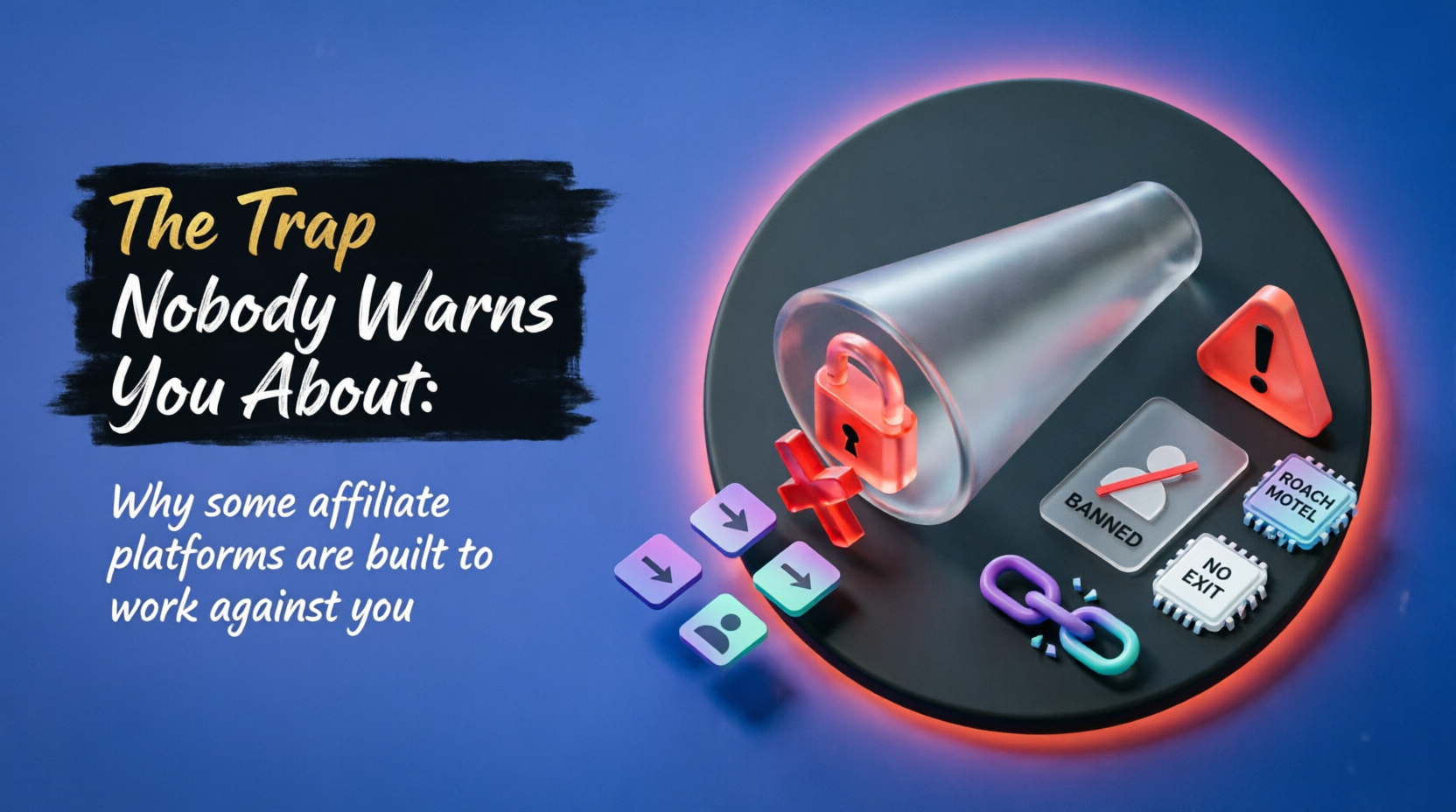
The Trap Nobody Warns You About: Why Some Affiliate Platforms Are Built to Work Against You
Here's a scenario that plays out more often than the affiliate marketing industry likes to admit. You spend months building an audience, learning exactly what your followers want to buy, and getting genuinely good at recommending products people go on to purchase. Then one day you log in to check your earnings — and instead of a dashboard, you find a locked account, a vague message about "unusual activity," and a balance you're told you may never see again. No explanation. No real appeal process. Just a wall.
If you've been in affiliate marketing for any length of time, some version of this has probably happened to you, or to someone you know. And here's the question almost nobody stops to ask out loud: is this an accident of bad software, or is it working exactly as designed? Understanding why this happens is the only way to actually protect yourself from it — and it's a big part of why we built VoxLinker the way we did.
A Design Rule That's Older Than the Internet
In 1994, usability researcher Jakob Nielsen published a list of ten principles that, three decades later, still quietly shape almost every piece of software you use. One of them matters more here than any other: users should always have a way out. Nielsen called it "user control and freedom" — no matter what state a person finds themselves in inside a piece of software, there should always be a clearly marked exit.
This isn't abstract design philosophy. It's the reason "undo" exists. It's the reason a good checkout flow always shows you how to leave if you change your mind. Most software respects this rule quietly, without you ever noticing — because when it's respected, you don't notice it at all. You only notice when it's broken.
The Pattern That Breaks the Rule on Purpose
In the world of digital products, there's a well-documented category of design that deliberately does the opposite. Interaction designers call it the Roach Motel pattern — easy to get into, deliberately difficult to get out of. You've probably felt a milder version yourself: a subscription that takes ten seconds to join and a phone call plus three confirmation screens to cancel.
In some corners of affiliate and CPC (cost-per-click) marketing, this pattern shows up in a far more aggressive form. Instead of a subscription you can't cancel, it's an account you can't leave cleanly — infinite loading screens, no exit button, a login flow that looks like it's about to let you in but never does, with no clear explanation of what happened. If you've ever felt like you were circling a drain trying to get out of an app that restricted you, that feeling wasn't an accident. It was, in a very literal sense, engineered.
So Why Would Anyone Build It This Way?
The honest answer isn't one simple villain — it's a handful of overlapping incentives, some more defensible than others.
- Discouraging ban evasion: if leaving a banned account is confusing enough, a bad actor may not bother creating a new one. The same friction lands on the honest creators flagged by mistake.
- Withholding confirmation on purpose: not telling a suspended user exactly why they were flagged can prevent gaming the system — but it gives a legitimate creator the exact same silence as someone who broke the rules.
- Simple broken code: sometimes an infinite loop isn't a trap at all, just a redirect condition nobody finished fixing.
- A genuine conflict of interest: on platforms that pay per click rather than per confirmed sale, the same company deciding whether your traffic "looks suspicious" is the company that keeps the money if it decides it does.
When the party judging your traffic and the party benefiting financially from that judgment are the same party, incentives quietly tilt against you — no bad faith required. That's not a conspiracy theory. It's just how misaligned incentives work.
Why Real Traffic Sometimes Looks Fake to a Machine
Here's what catches a lot of genuinely honest creators off guard: the traffic patterns that get flagged as suspicious are often the exact patterns a successful creator produces. Picture a creator with an engaged Facebook group. When they share a link, dozens of people click it within minutes, from the same referring page. To a fraud-detection algorithm built to spot bot networks, that burst can look statistically identical to coordinated fake traffic — not because the algorithm is lying, but because from a pure numbers standpoint, viral and fraudulent can look the same.
This is exactly why cost-per-click programs tend to have a rockier relationship with high-performing social traffic than cost-per-sale programs do. A platform that only pays out on a confirmed purchase has far less financial exposure to a click-volume spike, so it has far less incentive to treat that spike with suspicion in the first place. For more on how conversion psychology actually works, see our companion piece on why people actually click affiliate links.
What This Actually Costs, and What It's Worth to Get Right
Independent research groups estimate invalid and fraudulent traffic costs the digital advertising and affiliate ecosystem tens of billions of dollars a year globally. That's a real problem, and any serious platform has to take fraud prevention seriously — including us. The issue was never that fraud detection should exist. The issue is how it's built, and whether the people on the other end of it get a clear answer or a wall.
Some of the largest, most scrutinized advertising platforms in the world have poured enormous resources into making their fraud detection accurate, not just aggressive — not because they're inherently more ethical, but because being wrong at their scale is expensive in ways a smaller, less scrutinized network doesn't face the same way. That difference in exposure shapes how careful, or careless, a platform can afford to be with real people's money.
How We're Building VoxLinker Differently
We didn't write this to score points against an industry we're not part of — we wrote it because we are part of it, and creators deserve to understand the systems they're trusting with their income. Here's what that means in real product decisions on VoxLinker:
- A restricted account can still browse normally. You're only redirected away from areas that genuinely require an active, verified status — not locked out of the entire platform.
- You always get a real exit. No infinite spinners, no dead ends. A clear explanation, plus a working way to leave, contact us, or come back later.
- We tell you what's actually happening, in plain language — not a vague notice designed to give you nothing to act on.
- Fraud detection stays server-side, where it belongs, instead of turning your dashboard into a hostage situation.
What to Look for, No Matter Which Platform You Choose
We'd rather you make an informed choice than a blind one, even if that choice isn't us. Before building your income on any affiliate platform, including this one, it's worth asking:
- Does the platform pay per click or per confirmed sale?
- Is there a real, written appeals process, or does "review" mean silence with no timeline?
- Does their terms of service allow forfeiting valid earnings mixed in with disputed traffic?
- If your account were restricted tomorrow, would you know exactly what to do next?
If the answer to that last question is "I have no idea," that's worth knowing before it happens to you, not after.
Frequently Asked Questions
Is it normal for affiliate accounts to get suspended without warning?
It happens more often than most creators expect, especially on cost-per-click programs. It's not necessarily a sign you did anything wrong — but it is a sign worth checking a platform's appeals process before you rely on it for income.
Why would real, organic traffic ever get flagged as fraud?
Fraud-detection systems look for statistical patterns like many clicks from one source in a short window. A genuinely viral post can produce the same pattern as a bot network, which is why honest creators sometimes get caught in filters built for bad actors.
What's the difference between cost-per-click and cost-per-sale affiliate programs?
Cost-per-click programs pay for every click regardless of purchase, which exposes them financially to click-volume spikes. Cost-per-sale programs only pay on a confirmed transaction, so they carry less incentive to treat a traffic spike as suspicious.
How does VoxLinker handle account reviews differently?
Restricted accounts can still browse the platform normally and always have a clear status and a working way out — reviews happen server-side, without trapping the user experience in the process. Learn more on our FAQ page.